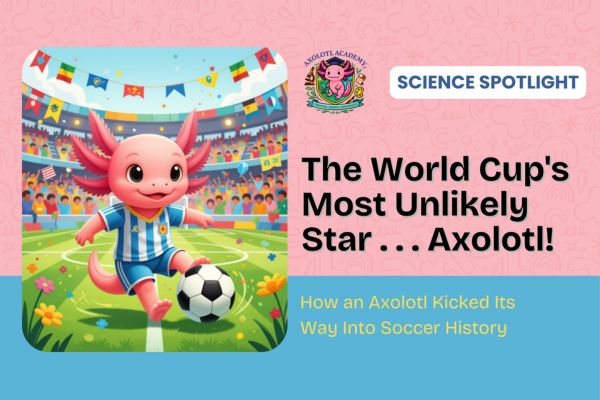
The World Cup's Most Unlikely Star: How the Axolotl Became Mexico City's Mascot (and Why That Matters)
The 2026 FIFA World Cup kicks off this month in Mexico City, and the city's most visible new celebrity is not a footballer. It is a small, smiling, critically endangered salamander called the axolotl.
The Takeover
If you walk through Mexico City right now, the axolotl is impossible to miss. Pedestrian bridges have been repainted in shades of purple, yellow, and pink. Underpasses are covered with giant murals. A light-rail train serving areas near the stadium has been transformed into a rolling pink axolotl. Mayor Clara Brugada unveiled "Ajolotin," a pink-crowned axolotl character, as the city's official mascot for tournament-related events. Near the stadium, a three-meter-tall axolotl statue wearing the Mexican national team jersey became an instant attraction for fans attending matches.
Then FIFA stepped in.
Under the commercial agreements governing World Cup branding, only the tournament's official mascots are permitted: Zayu the Jaguar for Mexico, Clutch the Eagle for the United States, and Maple the Moose for Canada. The Mexican Institute of Industrial Property confirmed that the axolotl figure violated FIFA's trademark protections. The statue was ordered removed.
But the axolotl was already everywhere else in the city, and in the hearts of the people who live there.
Why an Axolotl?
At first glance, the choice seems obvious. The axolotl is unmistakably Mexican. It is visually distinctive, instantly recognizable, and already familiar to millions of people worldwide through social media and the video game Minecraft. Its permanent smile makes it one of the most photogenic animals on earth.
But the roots go deeper than marketing.
The word "axolotl" comes from Nahuatl, the language of the Aztecs. It translates roughly to "water dog." In Aztec mythology, the rebel god Xolotl transformed himself into an axolotl to hide in the lakes beneath Tenochtitlan, the great city that stood where Mexico City stands today. The animal thrived for centuries in the chinampas, the ingenious floating farms that sustained the Aztec capital.
Mexico City did not choose the axolotl. The axolotl was always there. The city just finally put it on the jersey.
The Part Nobody Wants to Talk About
Here is where the smile fades. While the axolotl is everywhere in Mexico City's public art, scientists trying to count axolotls in the wild say they have not seen a single one in two years.
Two decades ago, there were roughly 6,000 axolotls per square kilometer in Lake Xochimilco, the last remnant of the ancient lake system where the species evolved. The most recent formal count found just 36 per square kilometer. The lake the city was built on was largely drained under colonial rule. What remains is being consumed and contaminated by urban sprawl, mass tourism, and pollution. Axolotls absorb oxygen through their skin, making them acutely vulnerable to water quality.
A backlash has emerged. Residents and scientists have coined the term "axolotlization" to describe the gap between the mascot's cheerful image and the animal's real survival crisis. Internet memes show Godzilla-like axolotls rampaging through the capital. The message is pointed: you cannot celebrate what you are not protecting.
Why This Matters Beyond the Match
This is the tension that makes the axolotl such a powerful symbol, not just for a football tournament, but for the broader question of how we relate to the natural world. The axolotl can regenerate amputated limbs. It can repair damaged heart and brain tissue. It has survived for millions of years in some of the most challenging ecosystems on the continent. And it is running out of room.
A new museum and conservation center at Mexico City's Chapultepec Zoo is working to change that, using the animal's fame to fund education and habitat restoration. UNAM, the national university, runs a virtual adoption program that channels donations directly into wild axolotl refuges.
The World Cup will bring billions of eyes to Mexico City this month. Whether those eyes see only a cute mascot or also see the creature behind it depends on whether we tell the full story.
Follow the Story
At Lotty & Finn, we have been writing about axolotls since before the World Cup made them famous. What they eat, how long they live, how they regenerate, why they matter, and what connects them to the mythology and ecology of Mexico. If you want to keep learning about this extraordinary animal long after the final whistle, follow along at www.LottyAndFinn.com/blog and look for our Science Spotlight series.
Sources:
Xinhua, June 4, 2026
U.S. News & World Report (Reuters), June 8, 2026
Riviera Maya News, May 2026
DevDiscourse, June 2026


