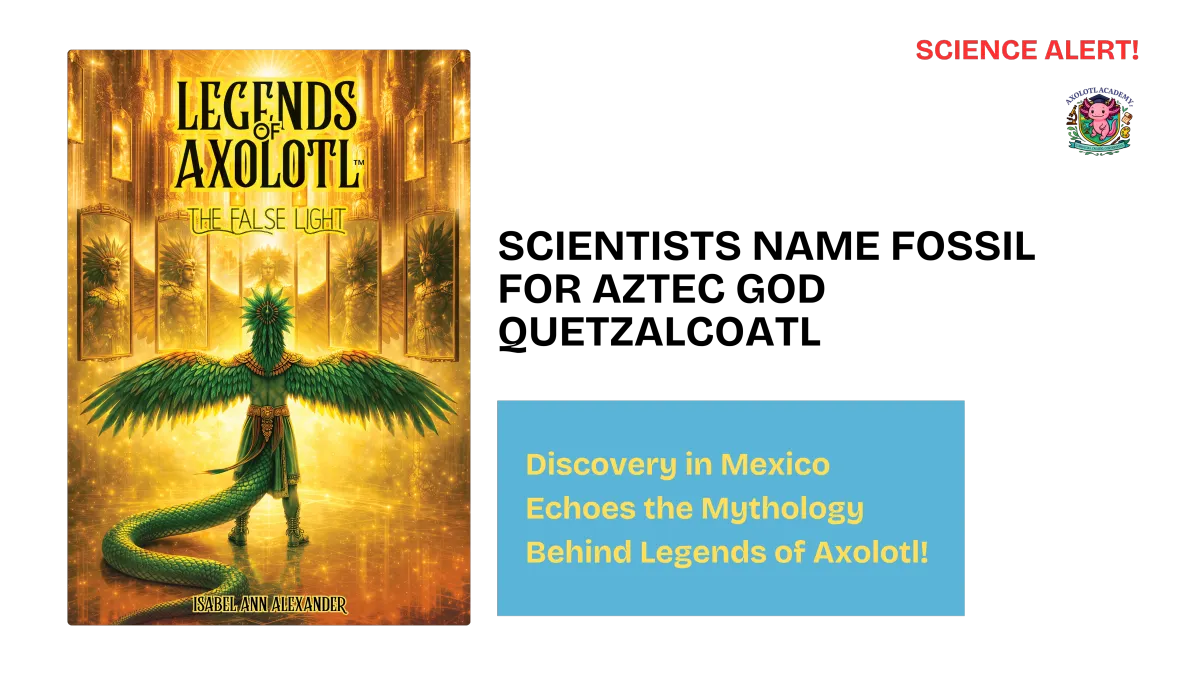
Science Just Confirmed Twin Aztec Gods: How a New Fossil in Mexico Echoes the Mythology Behind Legends of Axolotl
There are moments when the world you have been building in your imagination quietly receives an envelope from the real world. The note inside says: this was real all along, in its own way, the whole time.
Last month, that envelope arrived for me.
The Discovery
In May 2026, a team of paleontologists from Mexico's National Autonomous University (UNAM) published a peer-reviewed paper in Palaeontologia Electronica announcing the identification of a brand new species of fossil axolotl.
The fossils came from Santa Maria Amajac, a town tucked into the highlands of the state of Hidalgo, roughly 100 kilometers north of Mexico City.
The creature lived in a now vanished mountain lake during the Late Pliocene, approximately 4.2 million years ago. This is not a small finding!
It is Mexico's first formally named fossil salamander species, and the oldest salamander record in the country. The fossils show that, like the modern axolotl beloved around the world, this ancient relative was neotenic. It retained its larval features into adulthood and never quite left the water that raised it.
The researchers named the species Ambystoma quetzalcoatli.
The Naming, Word for Word
This is the part of the story I keep returning to. The scientists did not choose the name for sound or flourish. They explained, in plain language in their published paper, exactly why:
"From the deity Quetzalcoatl, a feathered serpent that was a patron god for the Aztecs and other Mesoamerican cultures. According to Aztec mythology, Quetzalcoatl was the twin brother of the god Xolotl, origin of the term Axolotl used for Mexican ambystomatid salamanders."
IMAGINE! A peer-reviewed scientific paper, in the year 2026, formally placed the twin god relationship of Quetzalcoatl and Xolotl into the permanent record of biological nomenclature.
The etymology of "axolotl" tracing directly back to the dog headed god Xolotl, Quetzalcoatl's twin, the one who descended into the underworld and, in some retellings, became the first axolotl himself.
This is not folklore being romantically invoked. This is two scientists at UNAM stating, for the record, that the modern word for the animal carries the name of the god, and that the god had a twin.
How This Maps to Legends of Axolotl
The Legends of Axolotl series is a middle grade adventure for readers eight to twelve, built on the spine of Aztec mythology and centered on the Axolotl Universe, my franchise vision for bringing these stories to young readers worldwide.
Book Two in the series - Legends of Axolotl - The False Light, is built around the Quetzalcoatl and Xolotl twin relationship.
Quetzalcoatl, the feathered serpent, the deity of wind and wisdom, the one whose brilliance could illuminate or deceive. Xolotl, his shadow twin, the lord of the underworld, the guide of the setting sun, the one whose form, mythology tells us, became the axolotl that still lives in the lakes of central Mexico.
The False Light is the story of the radiance you cannot quite trust, and the shadow twin who carries the harder truth. That story is not invented. It is older than all of us. I wrote it for kids who deserve to inherit it.
To have peer-reviewed science publish the exact mythological reasoning that anchors Book Two, in the same month Book Three of the series went to print, is not a coincidence I can rationally explain. I can only celebrate it and keep working on the series expansion.
Why Myth and Science Keep Finding Each Other
Mythology is often dismissed as humanity's first guess at how the world worked, a placeholder until science arrived to set things straight. I have never believed that. Mythology is observational.
The Aztecs lived among these salamanders for centuries. They watched them refuse to grow up, regenerate lost limbs, descend into the dark water, and emerge again. They saw something divine in this animal. They named it after a god.
Now, 4.2 million-year-old fossils of that same animal's distant cousin are being unearthed from a Mexican mountain lake, and the scientists holding them in their hands are reaching for the same name. Not because they are sentimental. Because the name fits.
This is what I want children to feel when they read Legends of Axolotl. That the stories adults sometimes file under "myth" are portals into something true - that science and story are not opposites. They are two versions to describe what we are still discovering.
The axolotl has been watching us learn this for longer than we have been watching it. The twins were always there. Science just confirmed them!
Where to Begin
If you are new to my Axolotl Universe and Chapter Book series: Legends of Axolotl - Book One, The First Axolotl, is the doorway.
Book Two, The False Light, is where the twin god mythology takes center stage.
Book Three, Through Obsidian Glass, released in May 2026.
All three are available on Amazon and at www.LegendsOfAxolotl.com.
If you teach, run a library, parent a young reader, or simply love the place where mythology and science meet, share this story. Hispanic Heritage Month is approaching. The timing could not be better.
Enjoy ALOTL!
Sources cited or referenced:
Herrera-Flores, J. A., and Velasco-de Leon, M. P. (2026). Ambystoma quetzalcoatli: a fossil axolotl from the Late Pliocene of central Mexico. Palaeontologia Electronica. DOI: 10.26879/1644
Phys.org coverage, May 26, 2026: https://phys.org/news/2026-05-fossil-salamander-species-famous-axolotl.html
Sci.News coverage, June 2026: https://www.sci.news/paleontology/ambystoma-quetzalcoatli-14811.html


